
The Evolution of Software Delivery
The traditional software development lifecycle, characterized by long release cycles, siloed teams, and manual deployment processes, no longer meets the demands of modern business. Organizations require rapid iteration, continuous improvement, and the ability to respond quickly to market changes and customer feedback. DevOps emerged as a cultural and technical movement to bridge the gap between development and operations, enabling faster, more reliable software delivery.
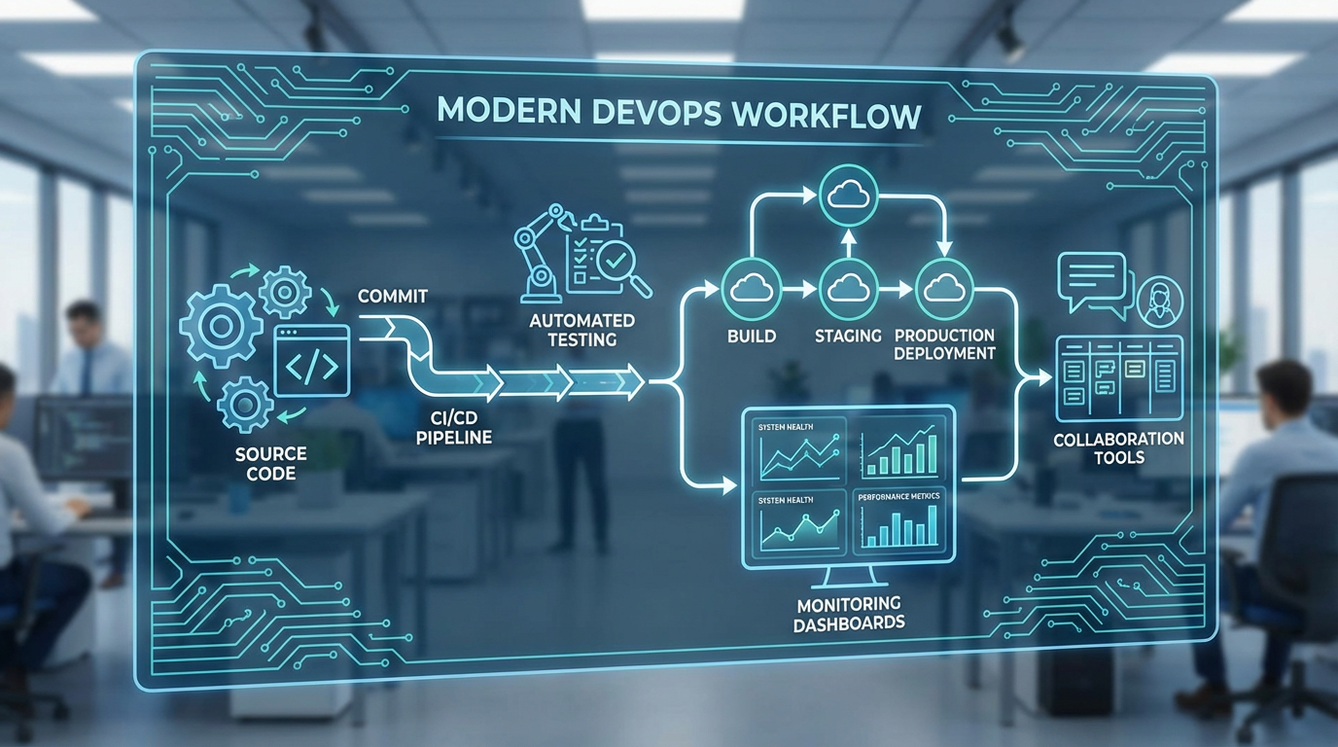
At its core, DevOps represents a fundamental shift in how organizations approach software development and infrastructure management. It breaks down barriers between teams, automates repetitive tasks, and establishes feedback loops that drive continuous improvement. The result is not just faster deployments, but higher quality software, improved collaboration, and better alignment between technology and business objectives.
Understanding Continuous Integration
Continuous Integration (CI) is the practice of frequently merging code changes into a central repository, where automated builds and tests run to detect integration issues early. Rather than working in isolation for extended periods, developers integrate their work multiple times per day, ensuring that the codebase remains in a deployable state.
Core Principles of CI
- Frequent Commits: Developers commit code changes to the main branch regularly, typically multiple times per day.
- Automated Builds: Every commit triggers an automated build process that compiles the code and creates deployable artifacts.
- Automated Testing: Comprehensive test suites run automatically to verify that new changes haven't broken existing functionality.
- Fast Feedback: Developers receive immediate notification if their changes cause build failures or test failures.
- Maintain a Single Source Repository: All code resides in a version control system accessible to the entire team.
Implementing Effective CI
Successful CI implementation requires more than just tools—it demands cultural change and disciplined practices. Start by establishing a robust version control workflow. Use branching strategies that support frequent integration, such as trunk-based development or short-lived feature branches. Ensure that your main branch always remains in a deployable state.
Invest in comprehensive automated testing. Unit tests verify individual components, integration tests ensure that different parts of the system work together correctly, and end-to-end tests validate complete user workflows. The faster your test suite runs, the more frequently developers can integrate their changes. Optimize test execution through parallelization, selective test running, and proper test organization.
Configure your CI server to build and test every commit automatically. Popular CI platforms like Jenkins, GitLab CI, GitHub Actions, and CircleCI provide the infrastructure to automate these processes. Set up notifications to alert developers immediately when builds fail, enabling quick remediation before issues compound.
Mastering Continuous Deployment
Continuous Deployment (CD) extends CI by automatically deploying every change that passes the automated test suite to production. This practice eliminates manual deployment processes, reduces the time between code completion and user availability, and enables organizations to deliver value continuously.
Building Deployment Pipelines
A deployment pipeline is an automated sequence of stages that code passes through from commit to production. Each stage validates different aspects of the change, providing increasing confidence that the code is production-ready. A typical pipeline includes build, test, staging deployment, and production deployment stages.
Design your pipeline to fail fast. Place quick, inexpensive checks early in the pipeline to catch obvious issues immediately. More comprehensive, time-consuming tests run later, after basic validation passes. This approach provides rapid feedback while ensuring thorough validation before production deployment.
Implement deployment automation that handles the complexity of releasing software across different environments. Use infrastructure as code to ensure consistency between development, staging, and production environments. Tools like Terraform, Ansible, and Kubernetes enable declarative infrastructure management that can be version-controlled and tested like application code.
Deployment Strategies
Different deployment strategies offer varying levels of risk mitigation and rollback capability. Blue-green deployments maintain two identical production environments, routing traffic to one while preparing the other with new code. This approach enables instant rollback by simply switching traffic back to the previous environment.
Canary deployments gradually roll out changes to a small subset of users before expanding to the entire user base. Monitor key metrics during the canary phase to detect issues before they affect all users. If problems arise, roll back the canary deployment before broader impact occurs.
Feature flags provide fine-grained control over functionality deployment. Deploy code to production with new features disabled, then enable them selectively for specific users or environments. This decouples deployment from release, allowing you to deploy continuously while controlling when features become available to users.
Automation Best Practices
Automation forms the foundation of effective DevOps practices. Every manual process represents an opportunity for human error, inconsistency, and delay. Identify repetitive tasks and systematically automate them, freeing teams to focus on higher-value activities.
Infrastructure Automation
Treat infrastructure as code, managing servers, networks, and cloud resources through version-controlled configuration files. This approach ensures reproducibility, enables testing of infrastructure changes, and provides a complete audit trail of modifications. When infrastructure is code, you can apply the same quality practices to infrastructure that you apply to application code.
Automate environment provisioning to eliminate configuration drift and ensure consistency. When developers can spin up complete environments on demand, they can test changes in isolation without affecting shared resources. Automated provisioning also accelerates onboarding, as new team members can quickly set up working development environments.
Testing Automation
Comprehensive test automation provides the confidence needed to deploy frequently. Implement testing at multiple levels: unit tests for individual components, integration tests for component interactions, contract tests for API boundaries, and end-to-end tests for critical user journeys.
Balance test coverage with execution speed. Exhaustive testing of every possible scenario isn't practical or necessary. Focus on high-value tests that catch the most common and impactful issues. Use techniques like risk-based testing to prioritize test coverage for critical functionality.
Collaboration and Culture
DevOps succeeds or fails based on culture and collaboration. Technical practices like CI/CD provide the mechanisms for faster delivery, but organizational culture determines whether teams embrace these practices effectively.
Breaking Down Silos
Traditional organizations separate development and operations teams, creating handoff points that slow delivery and obscure accountability. DevOps encourages cross-functional teams where developers share responsibility for operational concerns and operations personnel contribute to development decisions.
Implement shared on-call responsibilities where developers participate in supporting the systems they build. This practice creates powerful feedback loops—when developers experience the operational pain points of their code, they're motivated to improve reliability, observability, and operational efficiency.
Blameless Post-Mortems
When incidents occur, focus on learning rather than blame. Blameless post-mortems examine what happened, why it happened, and how to prevent similar issues in the future. This approach encourages transparency and continuous improvement rather than defensive behavior and finger-pointing.
Document lessons learned and share them broadly. Incidents provide valuable learning opportunities not just for the teams directly involved, but for the entire organization. Create a knowledge base of post-mortems that teams can reference when designing new systems or troubleshooting issues.
Monitoring and Observability
Effective DevOps requires deep visibility into system behavior. Monitoring tracks known metrics and alerts when they exceed thresholds. Observability goes further, enabling teams to ask arbitrary questions about system behavior and understand complex, emergent issues.
Key Metrics to Track
The DORA (DevOps Research and Assessment) metrics provide a framework for measuring DevOps performance: deployment frequency, lead time for changes, time to restore service, and change failure rate. These metrics correlate strongly with organizational performance and provide objective measures of improvement.
Implement comprehensive logging that captures relevant context for troubleshooting. Structure logs in machine-readable formats that enable efficient searching and analysis. Use correlation IDs to trace requests across distributed systems, making it possible to understand complete transaction flows.
Alerting Strategy
Design alerts that are actionable and meaningful. Alert fatigue occurs when teams receive too many notifications, especially for issues that don't require immediate action. Focus alerts on symptoms that impact users rather than every possible technical anomaly. When an alert fires, it should be clear what action needs to be taken.
Implement progressive alerting that escalates based on severity and duration. Minor issues might generate notifications without paging on-call personnel, while critical user-impacting problems trigger immediate escalation. This approach ensures that urgent issues receive immediate attention while reducing unnecessary interruptions.
Security in DevOps
Security cannot be an afterthought in fast-paced DevOps environments. DevSecOps integrates security practices throughout the development and deployment pipeline, ensuring that security keeps pace with delivery speed.
Shift Left Security
Address security concerns early in the development process rather than discovering them late in production. Implement automated security scanning in your CI pipeline to detect vulnerabilities in dependencies, identify insecure coding patterns, and verify compliance with security policies.
Provide developers with security tools and training that enable them to write secure code from the start. When security is everyone's responsibility rather than a separate team's concern, it becomes integrated into daily practices rather than a bottleneck at the end of development.
Conclusion
Mastering DevOps and CI/CD requires commitment to continuous improvement, investment in automation, and cultural transformation. The technical practices—automated testing, deployment pipelines, infrastructure as code—provide the foundation. But lasting success comes from fostering collaboration, embracing failure as a learning opportunity, and maintaining relentless focus on delivering value to users.
Start small, demonstrate value, and expand incrementally. You don't need to transform everything overnight. Choose a single team or project, implement CI/CD practices, measure the results, and use that success to drive broader adoption. Over time, these practices become ingrained in how your organization builds and delivers software, enabling you to move faster while maintaining quality and reliability.